

Overcoming siloed operations and accelerating digital transformation


For decades, legacy insurance systems have served as the operational backbone of carriers, managing policy administration, claims, billing, underwriting, and customer information. These platforms have proven reliable, but today's competitive environment demands capabilities they were never designed to support.
Artificial intelligence, predictive analytics, omnichannel customer experiences, real-time decision-making, and intelligent automation all depend on connected, accessible, high-quality data. Unfortunately, many insurers still operate across disconnected policy administration systems, aging mainframes, siloed databases, and manual workflows that make innovation increasingly difficult.
Digital transformation in insurance is no longer simply about replacing legacy technology. It is about creating an integrated enterprise where information flows seamlessly across departments, employees spend less time managing systems, and leadership gains real-time visibility into operations.
Organizations that successfully modernize legacy insurance systems position themselves to improve operational efficiency, reduce costs, accelerate product innovation, and build the data foundation required for AI-driven decision making.
What does legacy insurance system modernization mean?
Legacy insurance modernization connects aging policy, claims, billing, and underwriting systems through integration, cloud technologies, automation, and data modernization to improve efficiency while enabling AI, analytics, and digital customer experiences.
Modernization does not necessarily require replacing every existing platform.

Leading insurers increasingly adopt a phased modernization strategy that preserves stable business capabilities while modernizing the surrounding technology ecosystem. Rather than disrupting the business through large-scale replacement projects, organizations focus on reducing operational complexity, improving interoperability, and exposing legacy data through modern integration architectures.
Successful modernization often includes:
- Modern API integration
- Cloud-enabled infrastructure
- Enterprise data platforms
- Workflow automation
- Process orchestration
- AI-ready data architecture
- Application modernization
- Real-time analytics
- Digital self-service capabilities
The objective is not simply newer technology. The objective is a more connected insurance enterprise.
Why legacy systems are slowing digital transformation
Many insurance organizations have accumulated technology over decades through acquisitions, mergers, product expansion, and regulatory changes.
The result is often a complex technology landscape consisting of:
- Multiple policy administration systems
- Independent claims platforms
- Separate billing applications
- Legacy CRM solutions
- Standalone underwriting systems
- Custom databases
- Mainframe environments
- Spreadsheet-driven reporting
Each system performs its intended function reasonably well. The challenge emerges because they rarely communicate efficiently with one another.
Common operational consequences include:
- Duplicate customer records
- Manual data entry
- Delayed reporting
- Inconsistent policy information
- Limited enterprise visibility
- Higher administrative costs
- Slow product launches
- Increased compliance complexity
Instead of employees focusing on customers, they spend valuable time reconciling information across multiple systems.
Six signs your legacy environment is holding the business back
1. Data Exists Everywhere—but Nowhere Together
Executives frequently discover that obtaining a complete customer view requires accessing several independent systems.
Customer service representatives navigate multiple applications.
Claims professionals re-enter information manually.
Underwriters rely on outdated reports.
Leadership waits days—or weeks—for enterprise reporting.
Without connected data, strategic decision-making becomes reactive rather than proactive.
2. Manual Processes Continue to Grow
Legacy systems often require employees to compensate for technology limitations.
Manual activities frequently include:
- Copying information between systems
- Spreadsheet reconciliation
- Email approvals
- Paper documentation
- Manual compliance reporting
- Repetitive policy servicing
These processes increase operational costs while introducing additional opportunities for human error.
3. AI Initiatives Cannot Scale
Artificial intelligence depends upon reliable, connected, accessible information.
Organizations often discover that AI projects stall because:
- Data quality is inconsistent.
- Systems cannot share information.
- Historical records remain inaccessible.
- Business rules differ across platforms.
- Enterprise data lacks governance.
Rather than deploying intelligent automation, organizations spend months preparing data.
4. Customer Expectations Have Changed
Modern policyholders expect experiences comparable to digital banking and retail.
They increasingly expect:
- Self-service portals
- Mobile policy access
- Real-time claim status
- Faster underwriting
- Personalized communications
- Immediate service
Legacy environments make delivering these experiences significantly more difficult.
5. Compliance Becomes Increasingly Complex
Insurance organizations operate within highly regulated environments.
Disconnected systems often require compliance teams to collect information manually from multiple applications before demonstrating regulatory adherence.
This increases operational risk while consuming valuable employee resources.
6. Innovation Takes Too Long
Launching a new insurance product should not require modifications across multiple independent applications.
Unfortunately, legacy environments frequently require:
- Duplicate configuration
- Manual testing
- Custom integrations
- Extensive quality assurance
- Long deployment cycles
The result is slower innovation and reduced competitive agility.
The business impact of operational silos
Technology silos create business silos.
When departments operate from different systems and different versions of the truth, collaboration suffers.
Claims, underwriting, finance, customer service, actuarial, and sales teams often make decisions using incomplete information.
The resulting business challenges include:
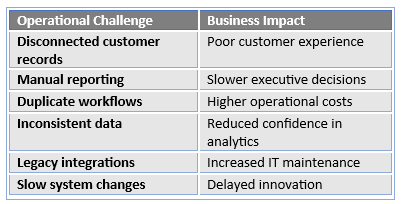
Over time, these inefficiencies compound, reducing organizational agility while increasing operating expenses.
Building a connected insurance enterprise
Digital transformation requires more than technology upgrades.
It requires connecting people, processes, applications, and data across the enterprise.
Leading insurers focus on several modernization priorities.
Modern Integration
Rather than replacing every application, organizations expose existing systems through APIs and integration platforms.
This enables data sharing across:
- Policy systems
- Claims platforms
- Billing
- CRM
- Customer portals
- Analytics platforms
- AI applications
Integration becomes the foundation for future modernization.
Intelligent Automation
Workflow automation eliminates repetitive administrative activities by routing information automatically across departments.
Examples include:
- First Notice of Loss (FNOL)
- Policy endorsements
- Claims routing
- Underwriting approvals
- Customer notifications
- Regulatory reporting
Automation improves consistency while reducing operational delays.
Cloud-Enabled Infrastructure
Cloud modernization improves scalability while supporting disaster recovery, business continuity, and flexible application deployment.
Organizations can modernize incrementally without disrupting mission-critical systems.
Enterprise Data Strategy
Modern insurers increasingly establish centralized data platforms that combine information from multiple operational systems.
Benefits include:
- Real-time dashboards
- Predictive analytics
- Better forecasting
- AI model development
- Customer 360 visibility
- Improved reporting
Data becomes an enterprise asset rather than a departmental resource.
AI Readiness
Many organizations focus immediately on artificial intelligence.
The more important question is whether their data infrastructure is prepared to support AI.
Successful AI initiatives require:
- Connected systems
- Trusted data
- Governance
- Integration
- Process standardization
Without these capabilities, AI projects rarely move beyond pilot programs.
A practical roadmap for legacy insurance modernization
Successful modernization rarely occurs through a single enterprise-wide replacement.
Instead, leading organizations adopt phased transformation strategies.
Phase 1: Assess current systems
Evaluate:
- Core applications
- Data quality
- Process maturity
- Integration gaps
- Infrastructure
- Security posture
This establishes a modernization baseline.
Phase 2: Prioritize business outcomes
Modernization initiatives should align with measurable business objectives such as:
- Faster claims processing
- Lower operational costs
- Improved underwriting efficiency
- Enhanced customer satisfaction
- Increased automation
- AI readiness
Technology should support business strategy—not drive it.
Phase 3: Modernize incrementally
Rather than replacing everything simultaneously:
- Integrate systems
- Modernize data
- Automate workflows
- Introduce cloud services
- Expand analytics
- Enhance customer experiences
Each initiative builds toward a connected enterprise.
Phase 4: Scale Innovation
Once operational foundations improve, organizations can expand:
- Predictive analytics
- Intelligent document processing
- AI-assisted underwriting
- Claims automation
- Fraud detection
- Customer personalization
Innovation accelerates because the underlying infrastructure supports change.
Why operational readiness matters more than technology replacement
Many modernization initiatives fail because organizations concentrate exclusively on software replacement.
Technology alone rarely transforms operations.
Successful insurers modernize:
- Business processes
- Data governance
- Integration architecture
- Organizational workflows
- Security
- Operational culture
This broader approach produces sustainable transformation while minimizing disruption.
The goal is not simply implementing new software.
The goal is enabling the business to adapt continuously as customer expectations, regulatory requirements, and technology continue to evolve.
The future of insurance belongs to connected enterprises
The insurance industry is entering a period where competitive differentiation will increasingly depend on operational intelligence rather than operational scale.
Artificial intelligence, automation, predictive analytics, and personalized customer experiences will become standard expectations rather than competitive advantages. Organizations still constrained by disconnected legacy systems will struggle to innovate at the pace required by the market.
The insurers that lead the next decade will not necessarily be those with the newest policy administration platform. They will be the organizations that have successfully connected their technology ecosystem, modernized their data foundation, automated routine operations, and created an enterprise architecture capable of continuous evolution.
Legacy modernization is therefore no longer an IT initiative. It is an enterprise transformation strategy that directly influences operational efficiency, customer satisfaction, regulatory agility, and long-term competitiveness.
.png)
FAQ
Can insurance companies modernize without replacing their core systems?
Yes. Many insurers adopt a phased modernization strategy that integrates existing systems using APIs, cloud services, automation, and modern data platforms while gradually replacing components over time.
Why do legacy insurance systems create operational silos?
Legacy systems often operate independently, storing data in separate databases and requiring manual processes to exchange information. This limits visibility, increases duplication, and slows decision-making.
How does legacy modernization support AI in insurance?
AI depends on connected, governed, high-quality data. Modernization improves integration, data accessibility, automation, and analytics, providing the foundation necessary for scalable AI initiatives.
What are the biggest benefits of insurance modernization?
Organizations typically experience:
- Improved operational efficiency
- Faster claims processing
- Better customer experiences
- Reduced manual work
- Stronger compliance
- Improved analytics
- Greater AI readiness
- Lower long-term technology costs
How should insurers begin a modernization initiative?
Start with a comprehensive assessment of current systems, operational workflows, data maturity, integration gaps, and business priorities. From there, develop a phased roadmap focused on measurable business outcomes rather than wholesale technology replacement.
Insights
Stay up to date on pivotal trends in information technology that are set to define the future of business. Subscribe to our blog today!


.png)

.png)




Our Core Capabilities

INFRASTRUCTURE
& CONNECTIVITY
connectivity and cloud.
.svg)

SECURITY

DIGITAL INNOVATION
& HYPER-AUTOMATION

INTELLIGENT
INSIGHTS & AI

TALENT
EXTENSION
