

How to turn AI automation opportunities into real business outcomes


Bridging the gap between artificial intelligence strategy and real-world impact requires a structured methodology that prioritizes evidence over hype. Claro's AI Discovery Framework transforms unstructured automation ideas into an executable, risk-adjusted 12-month roadmap. By aligning technical feasibility, business value, and governance from day one, organizations can confidently sequence their AI investments for maximum return. Read this guide to understand how to systematically evaluate, score, and operationalize enterprise AI initiatives.
Key Takeaways
- AI initiatives scale successfully when organizations replace unstructured idea generation with an evidence-based discovery framework.
- Effective prioritization relies on multi-dimensional scoring that evaluates business value, strategic urgency, readiness, and governance burdens.
- Maturity-based sequencing ensures that foundational prerequisites—such as data readiness and talent availability—are met before launching high-impact automation projects.
- Implementing risk-based governance early in the process categorizes initiatives by exposure, ensuring compliant and responsible AI deployment.
- The structured 7-step process yields a concrete 12-month roadmap and an actionable 90-day mobilization plan aligned with executive goals.
Why do most enterprise AI initiatives fail to scale?
Most enterprise AI initiatives fail to scale because organizations lack a rigorous mechanism to prioritize automation opportunities and evaluate execution readiness. Without an evidence-based approach, businesses invest in projects that are technically unfeasible, misaligned with strategic goals, or burdened by unmanaged risks.
Why is idea generation insufficient without prioritization?
Generating hundreds of automation ideas often leads to resource exhaustion when organizations fail to prioritize them effectively. Claro recognizes that high-volume idea generation creates an illusion of progress. A lack of structured filtering results in backlogs of theoretical concepts that never reach deployment. Organizations must transition from brainstorming to applying rigorous thresholds that identify which initiatives deliver measurable business benefits.
How does a lack of evidence impact decision-making?
Decisions made without an evidence foundation result in misallocated budgets and failed deployments. Executives frequently approve projects based on subjective preferences or vendor marketing. An effective framework categorizes evidence quality into High, Medium, or Low confidence tiers, ensuring that recommendations are based on traceable facts rather than assumptions or unresolved questions.
Why is execution readiness frequently overlooked?
Execution readiness is frequently overlooked because leaders focus on the technology's potential rather than the organization's maturity. Scoring an initiative highly on potential business value does not mean the organization is ready to build it. Companies must identify the specific activation conditions—such as data quality or integration readiness—that must be true before an initiative can safely proceed.
What happens when governance and risk are addressed too late?
Addressing governance and risk late in the deployment cycle leads to regulatory exposure, security breaches, and project delays. For AI and high-impact automation, control expectations must be integrated from the beginning. Assigning risk lanes (Lane A, B, or C) based on financial exposure, data sensitivity, and the reversibility of automated actions prevents compliance roadblocks during implementation.
What are the core components of a successful AI discovery framework?
A successful AI discovery framework requires five core components: an evidence register, an initiative catalog, a multi-dimensional scoring method, maturity-based sequencing, and a risk posture model. Claro incorporates these elements to ensure every automation recommendation is traceable, objective, and secure.
Learn more about our digital innovation hyper-automation capabilities.
How does a centralized evidence foundation support decisions?
The evidence register acts as the backbone of the AI discovery process, ensuring all recommendations trace back to verified facts. It houses interview records, workshop outputs, client artifacts, and explicit confidence notes. Every major recommendation must be supported by this register, clearly separating established facts from working assumptions.
What is the role of a structured initiative catalog?
The initiative catalog serves as the working inventory for all potential automation projects, tracking them from a broad long list to a finalized recommendation. It documents the problem statement, target workflow, expected business effect, and known dependencies. Initiatives are processed through various depths: Screen depth for initial evaluation, Compare depth for shortlisted items, and Decide depth for final executive packaging.
How does multi-dimensional scoring improve decision quality?
Multi-dimensional scoring supports decision quality by objectively evaluating initiatives across seven standardized criteria using a 1-to-5 scale. A score of 1 indicates weak viability, while a 5 demonstrates strong near-term fit.
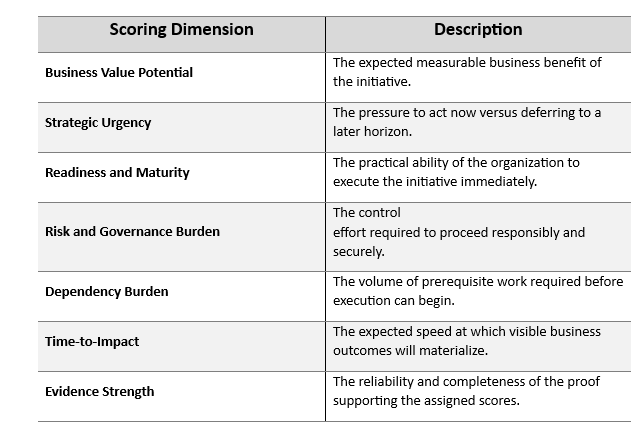
Choose an initiative for the shortlist when it scores 3 or above on business value potential and at least two other dimensions at the Screen depth.
How does maturity-based sequencing structure the roadmap?
Maturity-based sequencing identifies the prerequisite work standing between selection and execution. While scoring determines if an initiative is worth pursuing, maturity assessment answers if it can begin now. Organizations assess readiness across strategy, data, architecture, and talent to define specific activation conditions. Initiatives that meet their activation conditions are placed in early waves, while foundational projects that unblock multiple priorities are sequenced first.
Why is risk-based governance required from day one?
Risk-based governance ensures that initiatives are evaluated for legal, financial, and compliance exposure before deployment begins. The framework utilizes a Standard review as the default risk screen and triggers a Deep review for high-exposure projects. This process generates a Lane Policy Card that documents the governance stance, ensuring secure, compliant AI adoption.
How does the end-to-end AI discovery process work?
The end-to-end AI discovery process moves through seven distinct steps over a multi-week period, taking an organization from initial scope definition to a finalized 12-month execution roadmap. This structured execution model guarantees stakeholder alignment and rigorous opportunity evaluation.
Step 1: How do you define scope and decision goals?
The process begins with a 2-to-3-day kickoff phase to set the operating frame for the engagement. The Solution Architect and customer sponsors confirm the business outcomes, define in-scope boundaries, and establish the initial evidence request list. Acceptance relies on confirming decision owners, setting a review cadence, and establishing a clear escalation path.
Step 2: How do you build the current-state baseline?
During the subsequent 3-to-4-day window, teams build a fact-based view of business, technology, and data readiness. Activities include leadership interviews, artifact reviews, and the classification of findings into facts, assumptions, and open questions. This step yields a validated current-state baseline and an updated evidence register.
Step 3: How are operations mapped and initiatives generated?
Over 3 to 4 days, workflow discovery sessions capture how work is actually done, documenting pain points, controls, and failure points. These pain points are converted into structured initiative records at Screen depth. The output is a de-duplicated, evaluation-ready long list of initiatives mapped to specific operational workflows.
Step 4: How are AI opportunities evaluated?
Evaluation takes 3 to 5 days and applies the scoring model, maturity assessment, and risk methods to the catalog. Teams perform standard reviews, trigger deep reviews where necessary, and identify activation conditions for each initiative. Candidates meeting the threshold are upgraded to Compare depth, ensuring the score rationale is auditable and evidence-linked.
Step 5: How do you prioritize the portfolio?
Portfolio prioritization spans 3 to 4 days and involves running trade-off sessions with decision owners. The goal is to build a top shortlist of three to five initiatives and upgrade them to Decide depth. Deferred and rejected items are explicitly documented with their corresponding logic, ensuring complete transparency in the selection process.
Step 6: How is the execution roadmap built?
This 3-to-5-day phase converts approved priorities into a practical 12-month sequence and a concrete 90-day action plan. Teams separate foundation work from outcome work based on sequencing constraints and activation conditions. Option sets are developed for priority initiatives, documenting trade-offs across speed, control, cost, and dependency.
Step 7: How do you secure executive alignment?
The final 3-to-5-day step consolidates all findings into a single recommendation narrative. Teams run traceability checks to ensure recommendations match the evidence and scoring data. The final output is an executive one-page decision pack, providing leaders with the exact rationale and immediate actions required to launch the mobilization plan.
What results can organizations expect from a structured AI approach?
Organizations utilizing Claro’s AI Discovery Framework achieve clear alignment between executive ambition and technical execution. By replacing guesswork with an evidence register and multi-dimensional scoring, businesses drastically reduce the risk of failed AI deployments.
The framework delivers actionable clarity. Instead of abstract strategy documents, executives receive a 12-month dependency-aware roadmap and a 30/60/90-day mobilization plan complete with named owners and identified blockers. This ensures that when the discovery phase ends, execution begins immediately. Choose this structured methodology if risk mitigation, rapid time-to-impact, and strict governance matter more than experimental brainstorming.
Execution is the real business differentiator
The true value of enterprise artificial intelligence lies in the ability to execute, not just in the capacity to generate ideas. Moving from ambition to operational impact requires discipline, objective scoring, and a deep understanding of organizational readiness. By implementing the seven steps of Claro’s AI Discovery Framework, your business can navigate complexities, unblock critical dependencies, and deploy automation that drives measurable ROI.
Experience best-in-breed technology solutions and turn your AI opportunities into an actionable roadmap today. Learn more about how to begin your automated discovery process with our expert team.
.png)
FAQs
How much does it cost to implement this AI discovery framework?
The cost of implementing the AI discovery framework depends entirely on the organizational scope, the number of workflows mapped, and the technical complexity of the current-state architecture. Because the methodology emphasizes rapid 2-to-5-day sprints per step, the overall engagement is designed to be highly cost-efficient, focusing budget on actionable execution rather than prolonged consulting phases.
What is the timeline for completing the AI discovery process?
The end-to-end AI discovery process typically takes between 20 to 30 business days to complete. The timeline is broken down into seven distinct steps, ranging from a 2-day kickoff phase to 5-day evaluation and packaging sprints. Adherence to this timeline requires prompt stakeholder availability and timely access to internal data and process artifacts.
What are the main risks involved in evaluating AI initiatives?
The primary risks during AI evaluation include proceeding with low-confidence evidence, ignoring critical data dependencies, and failing to secure executive alignment. The framework mitigates these risks by utilizing an evidence register, enforcing Gate 1 to Gate 3 internal quality checks, and applying risk lane assignments (Lane A, B, or C) to evaluate legal, financial, and compliance exposures early.
Are there alternatives to a formal AI discovery framework?
Yes, organizations can choose an ad-hoc or decentralized approach where individual departments source and deploy their own AI tools. However, this alternative frequently leads to shadow IT, incompatible tech stacks, and severe security vulnerabilities. Choose the structured discovery framework if enterprise-wide scalability, secure governance, and measurable ROI matter more than isolated departmental experiments.
Who is Claro's AI Discovery Framework for?
This framework is designed for mid-sized to large enterprise businesses seeking to systematically evaluate and deploy artificial intelligence and automation solutions. It is specifically tailored for C-suite executives, IT leaders, and operations managers who require an evidence-based, vendor-neutral methodology to transition from strategic AI ambition to secure, operational execution.
Insights
Stay up to date on pivotal trends in information technology that are set to define the future of business. Subscribe to our blog today!

.png)

.png)
.png)




Our Core Capabilities

INFRASTRUCTURE
& CONNECTIVITY
connectivity and cloud.
.svg)

SECURITY

DIGITAL INNOVATION
& HYPER-AUTOMATION

INTELLIGENT
INSIGHTS & AI

TALENT
EXTENSION
