

Why manufacturing digital transformation often fails (and how to fix it)
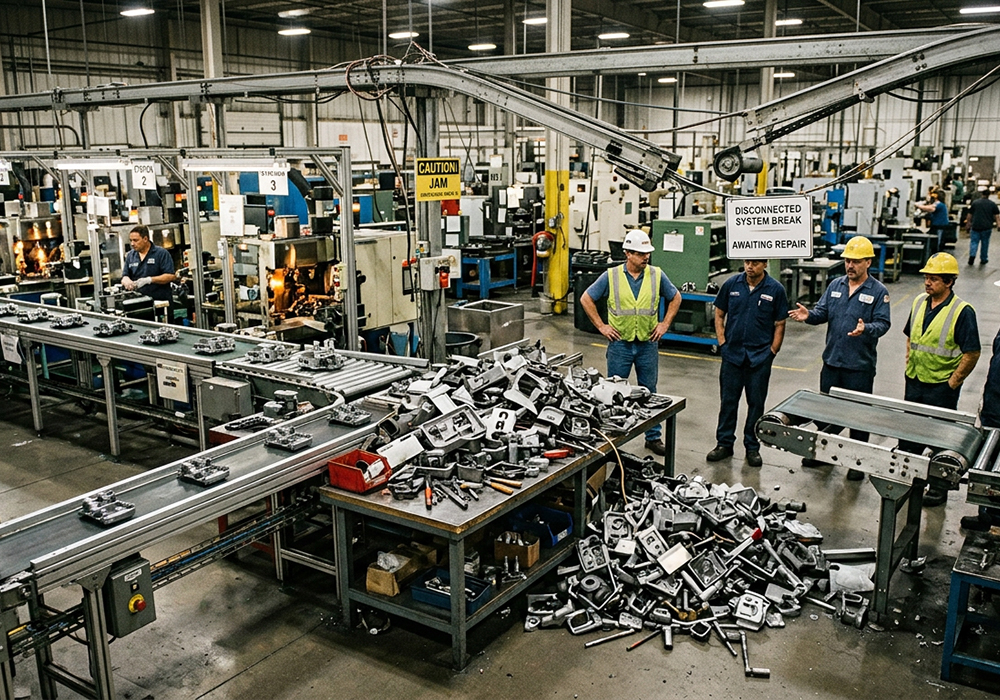

Manufacturing digital transformation initiatives often fail because organizations struggle with fragmented systems, disconnected teams, and unclear execution strategies. Without alignment between operations, technology, and business goals, modernization efforts stall before delivering measurable results.
Technology is rarely the problem.
Most manufacturers already have access to powerful tools, cloud platforms, automation solutions, analytics systems, and AI capabilities. The challenge lies in connecting these technologies to business objectives, operational processes, and organizational change.
As manufacturers face increasing pressure to improve productivity, reduce costs, strengthen supply chain resilience, and adopt AI, successful transformation requires more than technology investments. It requires a structured approach that aligns systems, data, people, and execution.
What challenges prevent successful manufacturing transformation?
Manufacturers face transformation challenges due to operational complexity, aging infrastructure, workforce shortages, and misalignment between business objectives and technology initiatives. These factors increase risk, delay projects, and limit transformation outcomes.
Manufacturing environments are among the most complex operating ecosystems in any industry. Production equipment, ERP systems, MES platforms, supply chain applications, quality systems, and industrial IoT devices often operate independently.
When organizations attempt transformation without addressing these foundational challenges, initiatives frequently lose momentum.
Common Manufacturing Transformation Challenges:
- Complex multi-site operations
- Legacy technology environments
- Limited workforce capacity
- Siloed organizational structures
- Manual and paper-based processes
- Inconsistent operational data
- Competing business priorities
- Difficulty measuring transformation outcomes
Over time, these challenges compound, making modernization efforts more expensive and difficult to execute.
How do fragmented systems impact manufacturing operations?
Fragmented systems limit data sharing across manufacturing environments, reducing visibility, slowing decision-making, and preventing organizations from fully leveraging automation, analytics, and AI technologies.
Many manufacturers operate with disconnected technology ecosystems.
Enterprise Resource Planning (ERP) systems manage business processes. Manufacturing Execution Systems (MES) control production workflows. Industrial IoT platforms collect machine data. Quality management systems track compliance. Yet these platforms often operate independently.
Without integration, organizations face significant operational inefficiencies.
Consequences of Fragmented Manufacturing Systems
- ERP and MES systems operate in silos
- Data must be manually reconciled across platforms
- Reporting becomes inconsistent and time-consuming
- Real-time visibility is limited
- Decision-making slows across departments
- Automation initiatives lack complete data inputs
As a result, organizations struggle to establish a single source of truth for operational performance.
What is the impact of failed digital transformation in manufacturing?
Failed digital transformation initiatives increase operational costs, reduce productivity, create production inefficiencies, and limit an organization's ability to compete in an increasingly automated and AI-driven manufacturing landscape.
Transformation failure affects far more than technology projects.
When modernization efforts stall, manufacturers often continue operating with outdated processes that create unnecessary costs and operational risk.
Business impacts of transformation failure
Increased Downtime: Disconnected systems make it difficult to identify and resolve production issues before they impact operations.
Higher Operating Costs: Manual processes, inefficient workflows, and reactive maintenance increase labor and maintenance expenses.
Reduced Innovation: Organizations spend more time managing legacy environments and less time pursuing innovation opportunities.
Lost Competitive Advantage: Competitors that successfully implement automation, AI, and integrated operations often achieve faster growth and stronger profitability.
The longer transformation remains stalled, the larger the competitive gap becomes.
How can manufacturers successfully modernize systems and operations?
Successful manufacturers align transformation strategy with business outcomes, integrate critical systems, automate manual processes, and establish governance frameworks that support measurable operational improvements.
Transformation success requires structure and execution.
Rather than pursuing isolated technology projects, leading manufacturers create modernization roadmaps that prioritize business outcomes such as productivity, efficiency, quality, and profitability.
Best practices for manufacturing modernization
Build an Outcome-Based Roadmap: Define measurable goals tied directly to business priorities.
Integrate Critical Systems: Connect ERP, MES, IoT, quality, and analytics platforms to improve visibility and coordination.
Automate Repetitive Workflows: Eliminate manual tasks that create bottlenecks and increase error rates.
Align Technology with Operations: Ensure digital initiatives directly support manufacturing performance objectives.
Organizations that focus on execution and alignment consistently achieve stronger transformation outcomes.
How do AI and automation improve manufacturing transformation?
AI and automation accelerate manufacturing transformation by delivering predictive insights, automating workflows, improving operational visibility, and enabling faster, more informed decision-making.
Artificial intelligence has moved beyond experimentation and is becoming a practical driver of manufacturing performance.
When supported by connected systems and trusted data, AI can transform how manufacturers operate.
Key manufacturing AI use cases
Predictive Maintenance: Identify equipment issues before failures occur, reducing downtime and maintenance costs.
Quality Control Automation: Use computer vision and AI models to detect defects faster and more accurately.
Production Optimization: Analyze production data in real time to improve throughput and efficiency.
Supply Chain Visibility: Improve forecasting and inventory management across suppliers and production facilities.
Operational Intelligence: Provide leaders with real-time dashboards and actionable insights.
AI helps manufacturers move from reactive operations to proactive decision-making.
How Claro enables successful manufacturing transformation
Claro helps manufacturers modernize operations through integrated infrastructure, AI-powered automation, data-driven insights, and specialized expertise that eliminate silos and accelerate measurable transformation outcomes.
Digital transformation requires more than technology.
It requires a partner that can connect infrastructure, security, data, automation, and execution into a unified strategy.
Claro's approach aligns with four interconnected business engines that support transformation across manufacturing environments.
Provides the secure connectivity, networking, cloud infrastructure, and operational foundation required for modernization initiatives.
Capabilities Include:
- SD-WAN and secure connectivity
- Cloud infrastructure modernization
- Network transformation
- Hybrid environment support
Enables workflow automation, application modernization, and AI-driven process improvement.
Capabilities Include:
- Workflow orchestration
- Robotic Process Automation (RPA)
- Custom software development
- AI integration services
Transforms operational data into actionable insights.
Capabilities Include:
- Data engineering
- Predictive analytics
- Real-time dashboards
- AI-powered decision support
Provides the specialized talent required to accelerate transformation execution.
Capabilities Include:
- Nearshore technical teams
- IT staff augmentation
- Managed service support
- Specialized manufacturing expertise
Together, these capabilities help manufacturers reduce transformation risk while accelerating business outcomes.
Ready to fix your manufacturing transformation strategy?
Manufacturing transformation succeeds when systems, data, operations, and business goals are aligned.
Claro helps manufacturers eliminate silos, modernize infrastructure, accelerate automation, and build practical transformation roadmaps that deliver measurable business results.
Schedule an AI & transformation discovery session to identify high-value opportunities and create a roadmap for modernization, automation, and long-term operational success.
.png)
FAQ
What is digital transformation in manufacturing?
Digital transformation in manufacturing involves using technology, data, automation, and AI to improve production processes, operational efficiency, and business decision-making.
Why do transformation projects fail in manufacturing?
Most projects fail due to disconnected systems, poor planning, lack of organizational alignment, unclear business objectives, and insufficient execution capabilities.
How can manufacturers reduce transformation risk?
Manufacturers can reduce risk by creating a clear roadmap, validating use cases, integrating systems, and aligning technology investments with measurable business outcomes.
What technologies drive smart factory transformation?
Common technologies include AI, Industrial IoT, cloud platforms, manufacturing automation tools, predictive analytics, ERP systems, and Manufacturing Execution Systems (MES).
How does AI improve manufacturing operations?
AI improves manufacturing by enabling predictive maintenance, automating quality control, optimizing production processes, and delivering real-time operational insights.
Insights
Stay up to date on pivotal trends in information technology that are set to define the future of business. Subscribe to our blog today!


.png)

.png)





Our Core Capabilities

INFRASTRUCTURE
& CONNECTIVITY
connectivity and cloud.
.svg)

SECURITY

DIGITAL INNOVATION
& HYPER-AUTOMATION

INTELLIGENT
INSIGHTS & AI

TALENT
EXTENSION
